Sports Performance Leg Sleeve
Project Overview
The goal of this project was to design a leg sleeve that would provide useful knee ligament health data to athletes, driving data-informed recovery and training. In this project I learned a lot about local data storage, Bluetooth with Arduino, and designing surface wearables for consumers.
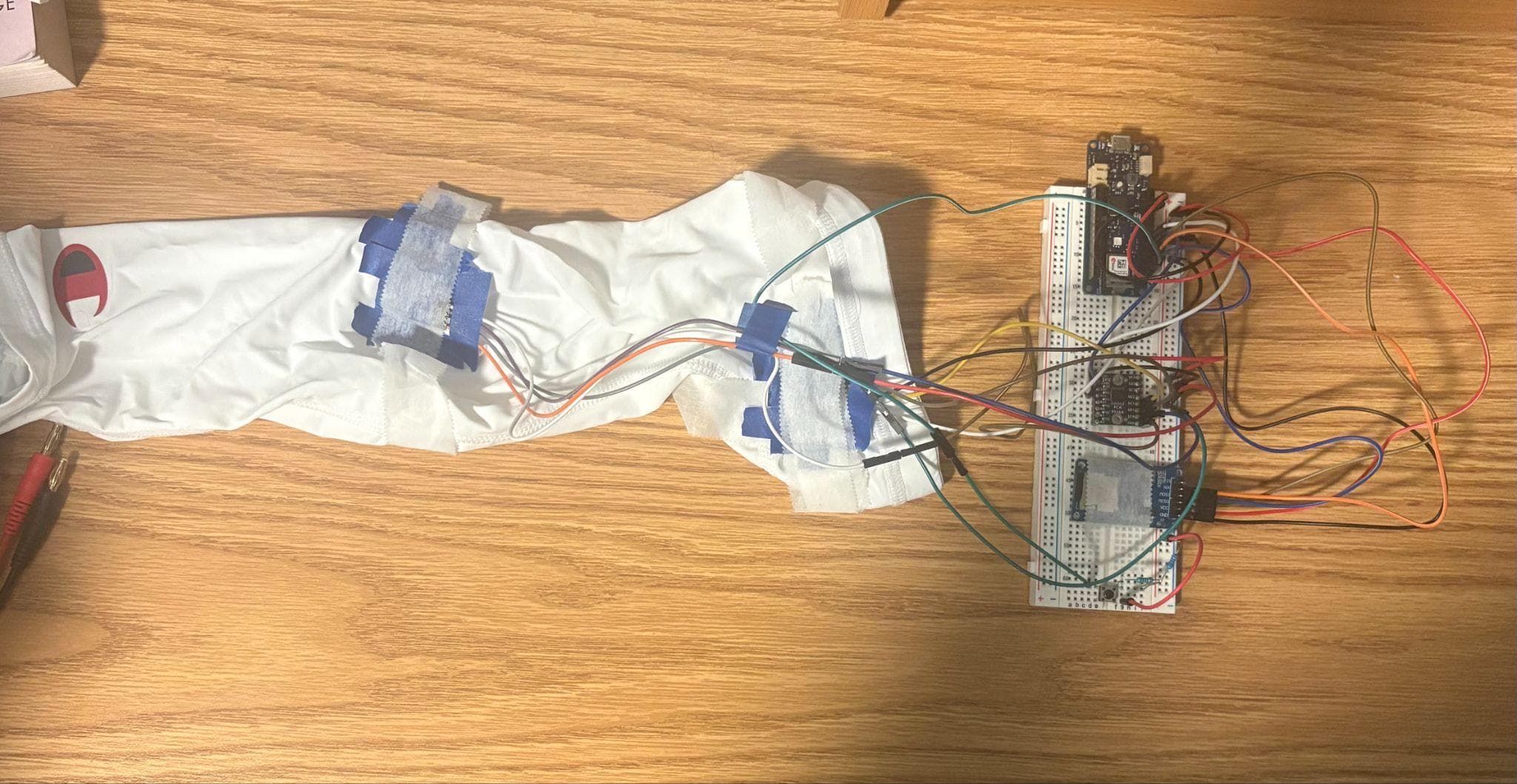
When designing the sleeve's layout, I began by researching knee ligament injuries and the biomechanical forces that cause them, since the sensors needed to be placed where they could capture those forces. From this research, I identified three primary mechanisms: axial loading, the vertical force on the knee during landing or deceleration; anterior tibial translation, the forward movement of the tibia relative to the femur; and rotational loading, specifically internal and external rotation of the tibia. By placing one IMU above the knee on the femur and another below the knee on the tibia, we could compare the two sensors' data to capture all three.
On the hardware side, I used an Arduino MKR WiFi 1010, one of Arduino's smallest IoT-enabled boards after the Nano. Unlike the Nano, however, the MKR WiFi 1010 has built-in LiPo battery support, which made it the clear choice for a wearable. Data was written to a microSD card through a breakout module, and the stored CSV files were then uploaded over the board's Bluetooth. A single button controlled the system: pressing it started and stopped data collection, and holding it entered Bluetooth sync mode. Finally, the two IMUs were inexpensive modules from Amazon, at about $3 each.
I partnered with a pre-med student to divide the work. I was responsible for the hardware and sensor design, and he was responsible for the data analysis and for making sure our data collection was accurate. Our initial plan was to estimate knee ligament stress by building a 3D spring model of the knee and relating it to the biomechanical forces described above. However, when we tested the sleeve with predictable, repeatable movements, the data showed no consistent pattern. Further research into other surface-mounted biomedical wearables pointed to a known problem: soft tissue artifact, in which the skin and the tissue beneath it move relative to the underlying bone, introducing error into the sensor readings. This made measuring ligament stress impractical for a device meant to stay affordable for athletes.
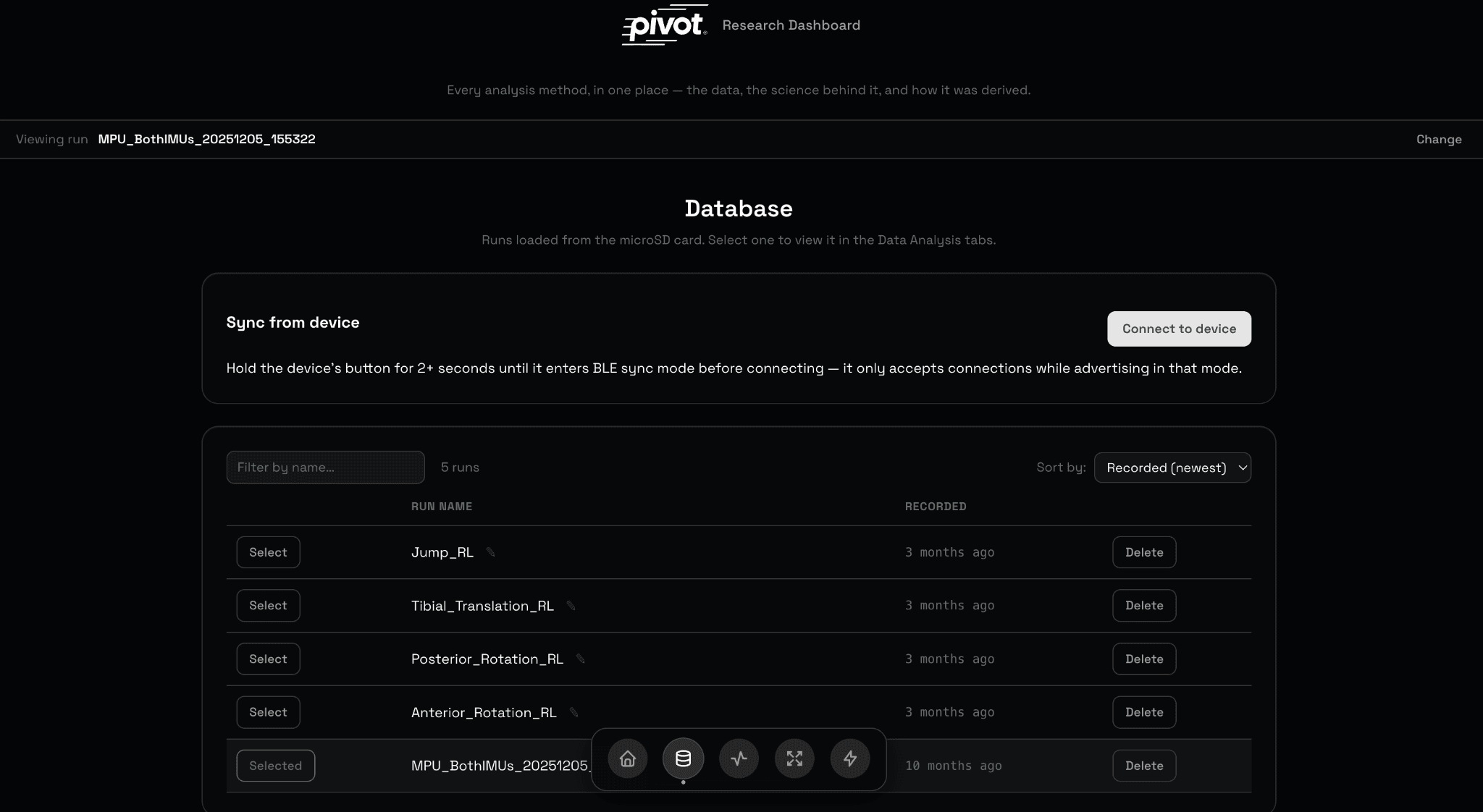
We decided to change our approach and instead make lower-error measurements. Specifically, the relative loading on the knee, the range of motion, and the landing mechanics. My co-developer worked on bundling these three metrics into a composite "Knee Health Score" using principal component analysis, while I built out the user dashboard where runs could be uploaded and results could be viewed.
This project is not currently being developed further, and there are no plans to take it to market. Still, it taught me a lot about how to scope a design around real-world constraints.